The systems the world will depend on tomorrow are being built today.
Claude is redefining how enterprises build and work, unlocking possibilities that were unimaginable just a few years ago. Palo Alto Networks is helping secure those possibilities.
95% of the Fortune 500 rely on us to help protect their businesses. We, in turn, use Claude to expand what's possible in cybersecurity.
This partnership represents more than technological innovation. It reflects a shared opportunity, and responsibility to help enterprises embrace frontier AI with confidence.
Because we cannot build the systems of tomorrow on an unprotected foundation.
Actionable Intelligence Is Here
Claude already helps developers navigate complex codebases, write software, and resolve problems faster. Knowledge workers use it to turn information into insight. Increasingly, AI agents are moving beyond recommendations to carry out multi-step work across applications and systems.
We have seen the implications firsthand. Through Anthropic's Project Glasswing, our teams have used frontier Claude models to uncover software vulnerabilities that earlier models missed. These advances are fundamentally changing cybersecurity, helping defenders discover hidden weaknesses earlier and respond faster. And as the window between vulnerability disclosure and exploitation continues to shrink, securing software demands a more proactive approach.
Yet frontier AI is not only changing how we defend software. It is changing how software is built and operated.
That shift demands a new approach to security.
Consider a developer using Claude Code. Within the permissions available to it, an agent can read private repositories, access secrets, modify files, execute commands, and connect to tools through the Model Context Protocol (MCP).
Now extend that activity across thousands of developers, endpoints, skills, and integrations. Add employees using Claude.ai and Claude Desktop for knowledge work, alongside teams building custom agents on the Claude API.
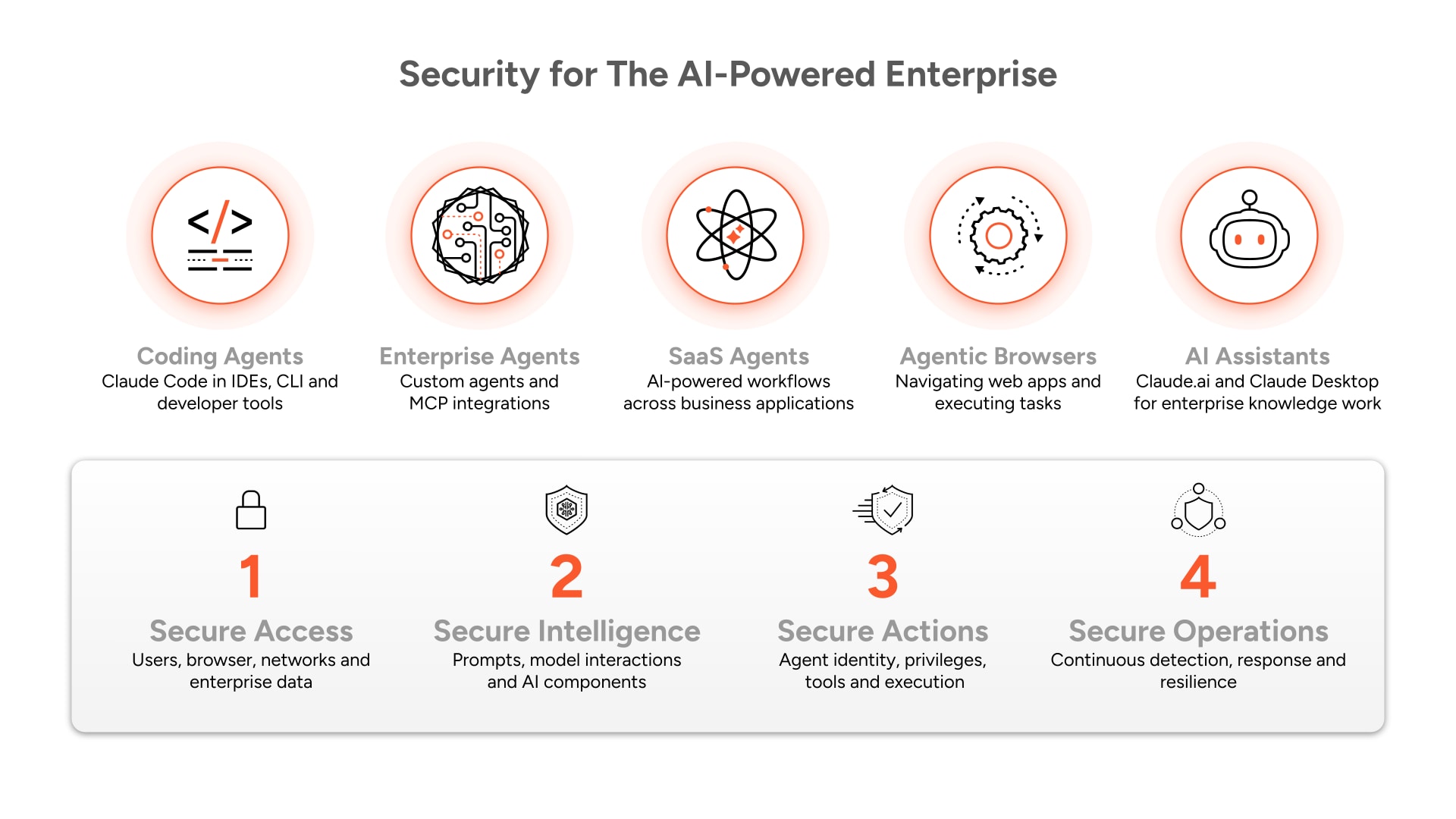
The challenge now extends beyond which applications an employee can access. It is a question of what an AI system can see, what it can change, and whose authority it uses to act.
A compromised skill, a prompt injection, an exposed credential, or an agent with excessive permissions can turn innovation into enterprise risk. Controls designed for known applications and actions taken at human-speed cannot simply be extended to account for how these systems operate.
We need security that follows AI from development through runtime.
Securing Claude Across the Enterprise
Our approach is to discover, assess, protect, and govern AI across its lifecycle, starting with AI coding and extending to knowledge work and autonomous agents.
The objective is straightforward: enable developers to build at Claude's speed, with security embedded into how AI is developed, deployed, and operated.
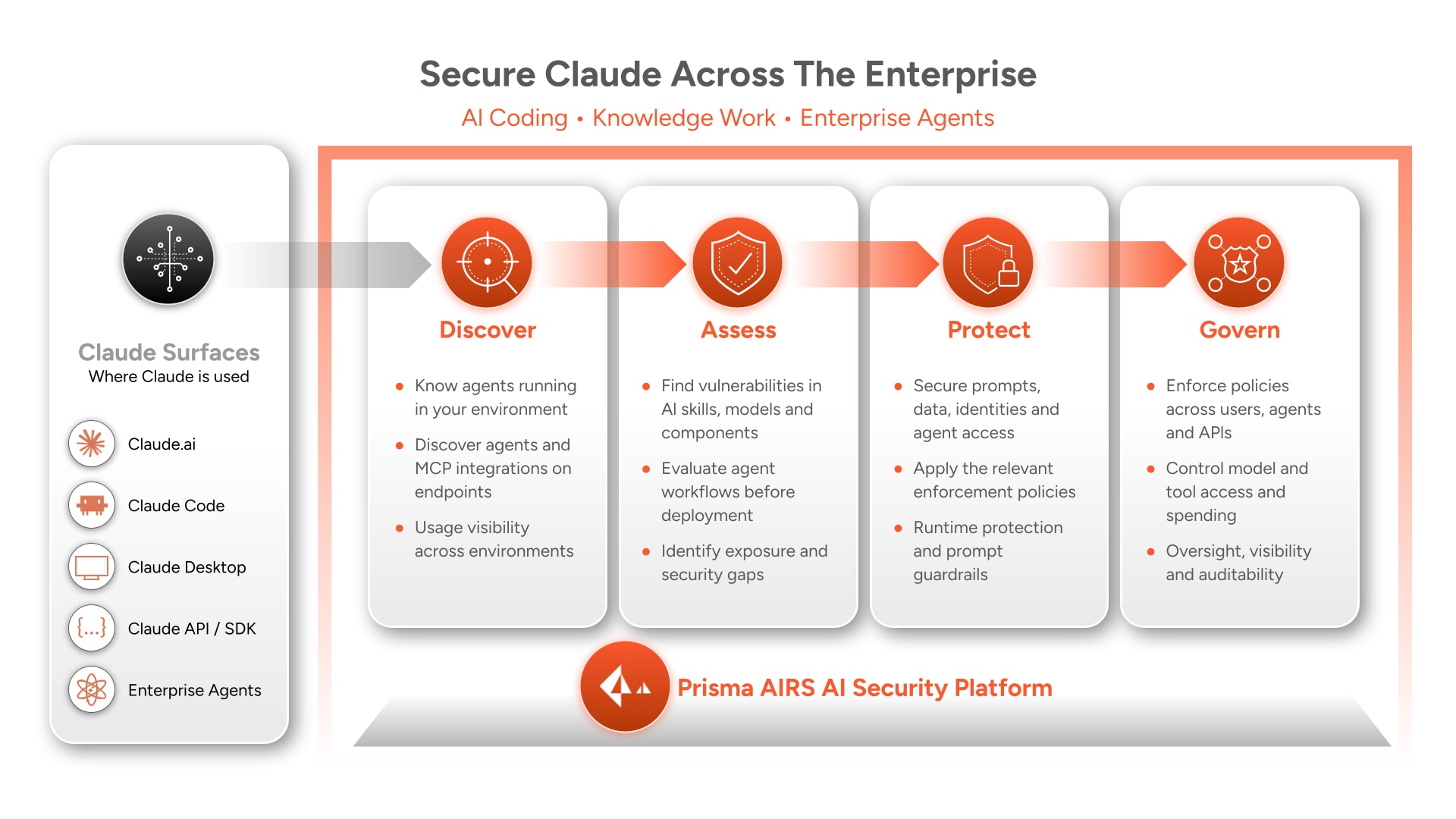
Discover what's running: Claude spans coding assistants in terminals and IDEs, local desktop applications, MCP connections, and enterprise APIs. Cortex Agentic Endpoint Security helps uncover coding agents, extensions, and MCP servers running in developer environments, giving security teams visibility into Shadow AI at scale. Across employee workflows, Prisma Browser and Prisma SASE provide complementary controls for access and data protection.
Assess what agents depend on: As development accelerates, teams increasingly rely on reusable skills, open-source models, and third-party integrations. Prisma AIRS AI Supply Chain Security scans models and agent skills for malicious code, backdoors, and other risks before deployment. AI Red Teaming proactively tests AI applications and agent workflows to uncover exploitable weaknesses before deployment. Secure development begins before an agent runs its first task.
Protect what agents access and do: Through native Claude Enterprise inference hooks, Prisma AIRS inspects governed prompts before inference, helping prevent sensitive data exposure and block malicious inputs. For Claude Code running on developer endpoints, Prisma AIRS, integrated with Cortex Agentic Endpoint Security, inspects prompts, responses, MCP tool calls, and supported network interactions to protect agentic workflows and enforce security policies at the endpoint. For custom applications built on the Claude API, Prisma AIRS extends runtime protection through AI Gateway or direct API integration. Agent Identity Security provides verifiable agent identities and just-in-time, least-privilege access to enterprise resources, reducing reliance on standing credentials.
Govern AI interactions and spend: Prisma AIRS AI Gateway enables teams to apply centralized policy to LLM, MCP, and A2A traffic, manage routing and access, and enforce quotas and rate limits. Usage analytics help show where and how AI is being consumed and the associated costs. Developers can innovate within clear enterprise boundaries, while security teams retain visibility and control.
The Foundation for What's Next
Securing the AI-powered enterprise requires more than protecting individual applications or deploying isolated security products. Palo Alto Networks brings together AI security, network and browser protection, identity, and Cortex security operations to protect the environments where people and agents work.
This is platformization for the AI era: coordinated security across the enterprise, designed to keep pace with the intelligence operating within it.
Claude is expanding what enterprises can build. Our responsibility is to help them trust what those systems access, create, and do.
Companies use Claude to help build the future. Palo Alto Networks can help secure it.
- Watch the Anthropic × Palo Alto Networks Fireside Chat: Hear how engineering leaders are operationalizing runtime security into practice for Claude Enterprise.
- Read the Secure AI Coding Solution Brief: Discover how to govern autonomous agents, protect code, and control AI costs.